Showing posts with label Venice. Show all posts

Sunday, February 27, 2011

The Fish Markets - Venice, Italy

The Fish Markets - Venice, Italy
The Fish Markets - Venice, Italy 

The Veince fish and fresh food markets were established in 1097 and have provided Venetians and tourists with their daily supplies of seafood, fruit and veggies since then. The markets, which are on the Grand Canal close to the Rialto bridge, open at dawn when the barges arrive and most of the stalls close by midday. As with most things in Venice, the markets provide photographers with yet another opportunity to spend a couple of hours capturing the goings on.

A vendor at the Fish Markets - Venice, Italy

The variety of fish and seafood on sale was amazing. Apart from a huge selection of fish, vendors were selling octopus, shrimp, crab, prawns and a number of other species of shell fish. We got to the markets at around 7.00 AM and found them already buzzing with activity as the locals did their daily shopping before heading off to work. The markets attract a number of tourists and quite a few companies offer tours and teach visitors how to compare the different varieties of fish that are available.

A vendor setting up a stall at the Fish Markets - Venice, Italy

The markets are closed on Mondays and the locals often advise people not to eat fish on Mondays as it is unlikely to be fresh. To give you some idea of the amount of seafood moving through the markets consider the fact that the local population of Venice is around the 60,000 mark and 20,000,000 visitors pour in to Venice each year. The majority of the seafood consumed by these people is sourced at these markets.

Scallops at the Fish Market - Venice, Italy

We wandered around the markets for about two hours, observing the goings on and photographing the activity. We used a combination of the Canon 7D and the 24-105mm lens and the Canon 400D and the 50mm lens to photograph the markets.

Produce at the markets - Venice, Italy

Zucchini Flowers - Venice, Italy

Friday, January 14, 2011

Murano Glass - Venice, Italy

A glass maker working on a vase - Murano, Italy
A glass maker working on a vase - Murano, Venice, Italy

Murano, a group of small islands situated about fifteen minutes by vaporetto from St Marks square, is famous for its glass makers. Glass making start in Murano in 1291 when the Venetian republic ordered all glass makers off the main islands fearing the foundries would would cause fires and destroyed the wooden buildings in Venice. Today, glass making remains the main industry on the island.

More images after the jump.

A glass vase being heated in a furnace - Murano, Venice, Italy

We visited Murano for a few hours while we were in Venice and browsed through a number of shops selling every type of glassware imaginable - from vases and liqueur glasses to glass beads and figurines as lamps and chandeliers. The manager of one of the larger shops we stopped at, offered to take us around the glass factory on the premises which supplied the store. We were keen to see the factory and accepted his invitation despite knowing that we would be expected to buy something from his store.

The finishing touches on a long vase - Murano, Italy
The finishing touches on a long vase - Murano, Venice, Italy

The factory was comprised of a number of small teams, each around 4 people strong which specialised in a particular type of glassware. One team constructed chandelier pieces, while another specialised in vases and yet another produced drinking glasses. Each team was led by a master craftsman who guided the other team members through the process of heating the glass and shaping the objects. Each member of the team was assigned a specific task in the manufacturing process.

Another vase taking shape - Murano, Italy
Another vase taking shape - Murano, Venice, Italy

We spent about twenty minutes in the factory before returning to the gallery to browse through the products and choose our souvenir of Murano.

All the images on this post were captured with a Canon 7D and the 24-105mm lens.

Tuesday, November 23, 2010

Gondolas and Gondoliers

A Gondolier waiting for a hire - Venice, Italy
A Gondolier waiting for a hire - Venice, Italy 

No trip to Venice is complete without a Gondola ride. The traditional flat bottomed rowing boat has been used on the Venetian lagoon for centuries. Although they were once the main mode of transport along the canals, they are now used for tourist rides. The earliest references to the Gondola were made in 1094 when a venetian public official referred to it in a letter. They started appearing in Italian paintings in the 1490's in works by Carpaccio and Bellini. The boat has evolved over the last 1000 years into the sleek familiar shape that it is today.

More info after the jump.

A Gondola parked along a canal - Venice, Italy

Gondolas were fitted with a small cabin, named the felce, until the early 20th century. Its windows could be closed with louvered shutters, the original venetian blinds. Gondolas were originally symmetric in design but at the end of the 1800's an asymmetric design which allowed a single oarsman was adopted. The boats are made out of 8 different types of wood and consist of 280 pieces.

At the peak of its popularity in the 17th and 18th century there were between eight and ten thousand Gondolas navigating the canals of Venice.

Tourists on one of the Venetian Canals - Venice, Italy

Contrary to popular belief the Gondola is not poled like a punt. Instead, the Oarsman propels the boat with a forward stroke and a compensating backward stroke. The oar, which is made out of beech wood, and is held in place by an oarlock known as a forcola. The forcola is a complicated shape as it has to allow for different speeds and directions of strokes. The ornament at the front of the Gondola is referred to as the ferro and is serves as a counter weight for the Oarsman. The ferro is generally made out of iron, brass, stainless steel or aluminium.

A Gondoliers hat - Venice, Italy

The profession of "Gondolier" is controlled by a guild which issues a limited number of licenses. In order to obtain a license, the Gondolier must complete training and an apprenticeship as well as pass a comprehensive exam. During this exam the applicants  knowledge of Venetian history, landmarks and foreign languages and practical skills in handling a Gondola are tested.

A Gondola navigating a canal - Venice, Italy

Gondola rides are available on almost every canal in Venice. We decided to take a ride along a few of the smaller canals as we wanted to avoid the Grand Canal which is constantly busy. The trip lasted around 40 minutes and we passed a number of famous landmarks on the way. These included Vivaldi's Palazzo as well as the Palazzo belonging to Marco Polo's family.

A Gondoliers hat - Venice, Italy

All images on this post were captured with the Canon 7D and the 24-105mm combo.

A Gondola navigates a Canal - Venice, Italy

Thursday, October 7, 2010

Venetian Masks

A Venetian Mask - Venice, Italy
A Venetian Mask - Venice, Italy 

Masks have been worn in several cultures, going back thousands of years, but never with such pageantry as in Venice. Venetian masks date back to the 13th century when Venice was a republic with a population of around 150,000. Nowadays, Venetians and tourists only wear masks during Carnevale (Mardi Gras) but in the 13th century masks were worn on a daily basis to conceal peoples' identities.

Read on for more images and info

A Venetian Mask - Venice, Italy

In the 13th century the Republic of Venice controlled several trade routes which extended beyond Constantinople. It also owned shipyards which were able to produce battleships in 30 days. This was possible because the shipyards employed 15,000 locals, a staggering 10% of the population. Apart from the shipyards, Venice also employed large work forces in other industries. Due to the high rate of employment Venetians were therefore wealthy and enjoyed a high standard of living.

A Venetian Mask - Venice, Italy

With time, some Venetians realised that by wearing masks, they were able to go about their daily lives and conduct certain business affairs in secrecy. They started making deals and agreements with other people, which, because of their hidden identity, did not fall within the gaze of the law.

A Venetian Mask - Venice, Italy

Masks also took social status out of the equation in peoples' dealings with each other. This prevented prejudice and allowed everyone to be treated as equals. Both citizens and officials visiting the city benefited from this as they were able to speak freely without fear of retribution and receive honest opinions.

A Venetian Mask - Venice, Italy

It didn't take long for people to start noticing the other "advantages" of remaining anonymous. Sexual promiscuity became common, women started flaunting their sexuality by wearing revealing clothing* and gambling was widespread throughout the day and night. Even those who had taken religious vows, such as monks and nuns, were tempted by and succumbed to the debauchery. In order to prevent complete moral decline, a decision was taken to ban masks altogether except on the days of Carnevale which was a time for fancy-dress parties and excessive celebrating.

A Venetian Mask - Venice, Italy

Masks are for sale at all souvenir shops and stalls around the main attractions, but a lot of them are of poor quality. You are sure to come across a number of shops dedicated entirely to authentic Venetian masks while wandering around the streets and alleys of Venice. We were lucky to walk into a store where the masks were being made and watched a lady painting and decorating a mask.

A lady making a mask - Venice, Italy

The images on this post were captured with either the Canon 7D or the Canon 400D with a 24-105mm lens or a 50mm lens.

* Source - http://www.eioba.com/a23168/the_history_of_the_venetian_mask

Tuesday, September 28, 2010

Venice

A pickup point for Gondolas in Venice
A pickup point for Gondolas in Venice 

In this post, I thought I would concentrate on some of the things that we first noticed while wandering around the floating city - not so much the things that one thinks of as quintessentially Venetian, such as gondolas and Carnevale masks, which I will look at in more detail in later posts.

The image above is of the main Gondola "pickup point" at St Marks square. A 5.30am start was required to photograph the area around St Marks square without tourists walking into the frame. This area is unbelievably busy during "normal" hours of the day. The church in the background is San Giorgio Maggiore on the island of San Giorgio.

Read on for more info and images.

A Vaporetto navigates the Grand Canal

Venice consists of two main islands, which are divided by the Grand Canal, and a number of smaller islands. The Grand Canal, as the name suggests, is the main waterway used to get around. It starts in the Venetian lagoon and ends in St Marks Basin. The areas along the two banks of the Grand Canal are very touristy and full of restaurants and souvenir shops.

A Gondola glides along the Grand Canal

There are 4 bridges which span the Grand Canal. Of these the Rialto is the best known and the oldest - in fact, until the middle of the 19th century, this was the only bridge to span the Grand Canal. The Rialto is named after the market on eastern bank of the canal. It was initially a pontoon bridge built in 1181 by Nicolo Barettieri. Due to increased traffic the bridge was replaced by wooden bridge in 1255.  The wooden bridge burnt once and collapsed on two separate occasions, the last of which was in 1524. The stone bridge which stands today was built in 1591. It is constantly packed with tourists, either taking pictures, looking out over the Grand Canal or browsing around the two rows of shops which span the length of the bridge.

The Rialto Bridge
The Rialto Bridge

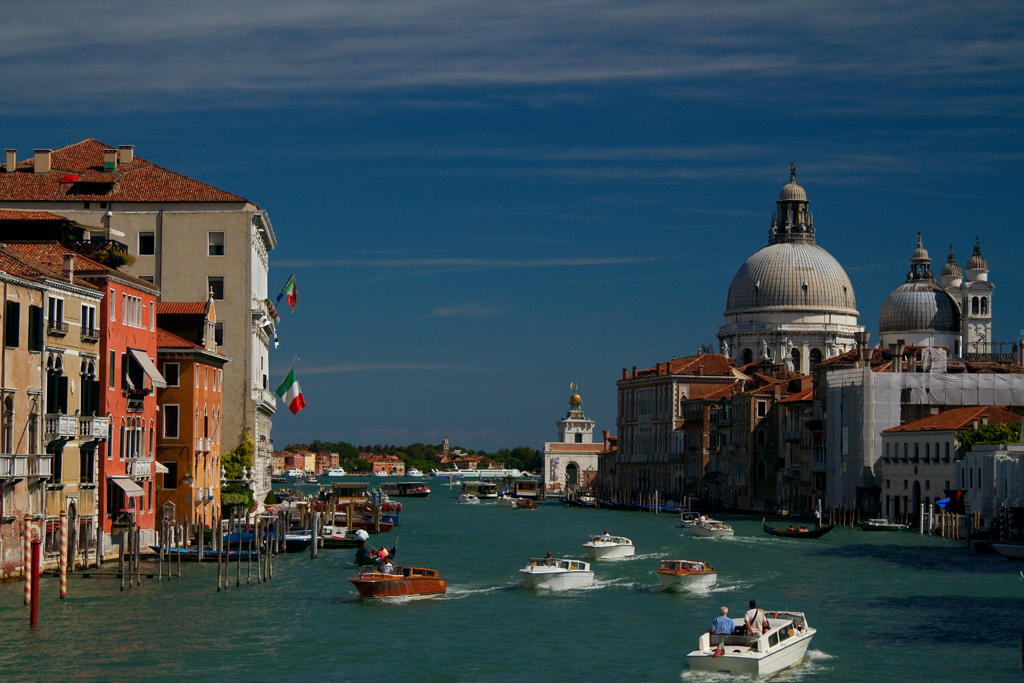
The Ponte dell' Academia is a relatively new wooden bridge across the Grand Canal. It is also the closest crossing to St Marks square. The entrance to the Gallerie dell' Academia is at the foot of this bridge on the eastern bank. The bridge offers two of the best views of Venice.

The Grand Canal photographed form the Academia Bridge

The islands of Venice are home to around 80 churches. Walking into most of these is like walking into small museums, as a number of them contain paintings and sculptures of the great Venetian artists including Tintoretto, Veronese and Titian.

>Santa Maria della Salute photographed from a Vaporetto
Santa Maria della Salute photographed from a Vaporetto

All these images were captured using a Canon 7D and a Canon 24-105mm Lens. I also had a circular polariser on the lens.