Showing posts with label Bird. Show all posts

Wednesday, December 14, 2011

Coppersmith Barbet - Anuradhapura, Sri Lanka

The Coppersmith Barbet phoographed in Anuradhapura, Sri Lanka
The Coppersmith Barbet - Anuradhapura, Sri Lanka

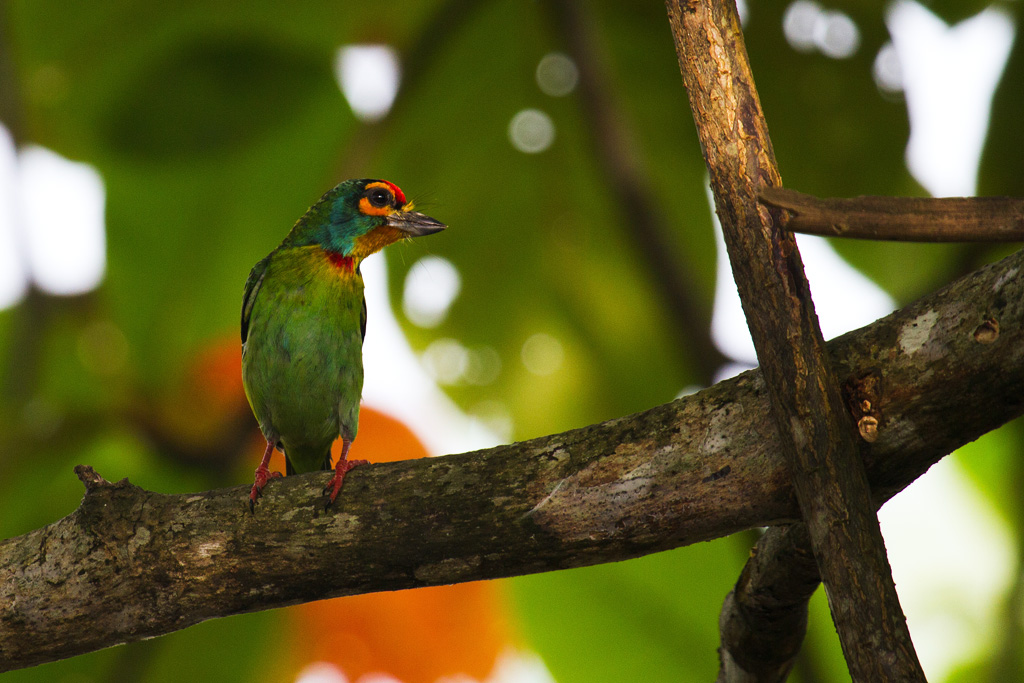
Of the resident Barbets of Sri Lanka, I have found the Coppersmith, or Crimson-breasted Barbet (Megalaima haemacephala), the hardest to photograph. I had seen the bird before but it had always been from a distance. Those sightings were not the best for photographing the Barbet as it is quite small.

The Coppersmith Barbet phoographed in Anuradhapura, Sri Lanka
The Coppersmith Barbet - Anuradhapura, Sri Lanka

My luck changed in July when I found a nest just outside the house in Anuradhapura. I was able to photograph the parents on a fairly regular basis from the verandah, as they flew in to feed the chicks. Each time they flew in with food, they appeared to clean up the nest and fly away with the rubbish.

The Coppersmith Barbet phoographed in Anuradhapura, Sri Lanka
The Coppersmith Barbet - Anuradhapura, Sri Lanka

According to GM Henry (Birds of Ceylon, 1954), the Coppersmith is found in the dry zone of sri Lanka and "does not penetrate far into the districts which receive the south west monsoon". However, they are not endemic and can be found in South and Southeast Asia. When compared to the other Barbets found in Sri Lanka, it is most similar to the Ceylon small Barbet. However, the Coppersmiths large red breast patch, pale yellow face and dusky green colouration help differentiate the two species.

The Coppersmith Barbet phoographed in Anuradhapura, Sri Lanka
The Coppersmith Barbet - Anuradhapura, Sri Lanka

These photographs were taken with a Canon 7D and the Canon 100-400mm lens. Conditions were not the best as the bird was in the shade and the sky in the background was blown out. Hopefully I'll get an opportunity to improve on these shots soon.


Wednesday, December 7, 2011

Ceylon Small Barbet - Thalangama, Sri Lanka

Photograph of a Ceylon Small Barbet taken in Thalangama, Sri Lanka
Ceylon Small Barbet - Thalangama, Sri Lanka

I have photographed the Ceylon Small Barbet (Megalaima rubricapilla), also called the Crimson-fronted Barbet, on several occasions. I have found them in the garden at home in Colombo and they are abundant at our place in Kandy. However, on these occasions the birds were some distance away.

More photographs inside.

Photograph of a Ceylon Small Barbet taken in Thalangama, Sri Lanka
 Ceylon Small Barbet - Thalangama, Sri Lanka

My luck changed on one of several visits to Thalangama in July. While I was walking along the bank of the tank I noticed a Black-rumped Flameback in one of the trees by the road. I stopped and photographed it for a few minutes and then noticed that a Golden Oriole had settled in the same tree. I was in the middle of photographing the Oriole when a Ceylon Small Barbet flew down onto one of the lower branches of the same tree.

Photograph of a Ceylon Small Barbet taken in Thalangama, Sri Lanka
Ceylon Small Barbet - Thalangama, Sri Lanka

I fired off about 15 or 20 frames and then stopped to watch the bird as I had not seen it in such close proximity before. My presence didn't seem to disturb it as it soon started moving along the branch pecking at the bark and foraging for insects.  It gradually worked its way up into the canopy and disappeared. Due to the colour of its plumage, it is not the easiest bird to find in the canopy.

Photograph of a Ceylon Small Barbet taken in Thalangama, Sri Lanka
Ceylon Small Barbet - Thalangama, Sri Lanka

These photographs were taken with the Canon 7D and the 100-400mm lens.The light wasn't the best and I bumped up the ISO to compensate.


Wednesday, November 23, 2011

Purple Coot - Thalangama, Sri Lanka

A photograph of a Purple Coot taken in Thalangama, Sri Lanka
Purple Coot - Thalangama, Sri Lanka

The Purple Coot, also know as the Purple Swamphen, is a common bird found in the lowland marshes of Sri Lanka. The subspecies found in Sri Lanka, Porphyrio porphyrio poliocephalus, is one of up to 13 subspecies identified through Europe, Africa, Asia and Australia. The thirteen subspecies mainly differ in the colour of their plumage.

More photographs after the jump.
A photograph of a Purple Coot taken in Thalangama, Sri Lanka
Purple Coot - Thalangama, Sri Lanka

Purple Coots are easy to identify because of their bright plumage and loud call. It is said to be able to fly long distances and for a bird without webbed feet, it is a good swimmer. They are seasonal breeders but the seasons vary across their range. The season correlates to the peak rainfall or summer temperatures in more temperate climates.

A photograph of a Purple Coot taken in Thalangama, Sri Lanka
Purple Coot - Thalangama, Sri Lanka

Multiple females may lay eggs in the same nest, which is built amongst reeds or other debris, and share incubation duties. Incubation lasts from 23-27 days and is performed by both males and females. "Helpers" are also known to assist with the incubation. After hatching, chicks are fed for a period of 10-15 days, after which they fend for themselves.

A photograph of a Purple Coot taken in Thalangama, Sri Lanka
Purple Coot - Thalangama, Sri Lanka 

Although the species is considered to be in the "least concern" category according to the IUCN, some subspecies have declined. This includes the subspecies found in the Mediterranean. An introduced population exists in Florida but biologists are trying to eradicate them.

A photograph of a Purple Coot taken in Thalangama, Sri Lanka
Purple Coot - Thalangama, Sri Lanka

These photographs were taken with the Canon 7D and the 100-400mm lens combo during several early morning visits to Thalangama.


Thursday, October 27, 2011

Common Iora - Thalangama and Yala, Sri Lanka

Photograph of a female Common Iora taken in Thalangama, Sri Lanka
Common Iora (female) - Thalangama, Sri Lanka

While I was in Colombo in July I visited the Thalangama wetlands almost every morning to photograph the bird life. On one of my visits I came across a few Common Ioras. I hadn't photographed them before and took the opportunity to shoot a few frames. The photograph above is one of my favourites because of the warm early morning light on the bird.

More photographs inside.

Photograph of a male Common Iora taken in Yala, Sri Lanka
Common Iora (male) - Yala, Sri Lanka

The males proved to be a bit more elusive and I wasn't able to get many shots of them. Males are unmistakable as their upper parts are a blue-black in colour where as the females are a dull yellow. The Common Iora is found throughout the lowlands and the mid hills of Sri Lanka. It is a very vocal bird but can be difficult to see due to it's plumage.

Photograph of a female Common Iora taken in Yala, Sri Lanka
Common Iora (female) - Yala, Sri Lanka

The male Common Iora is said to perform an "acrobatic courtship display" during the breeding season. It is said to puff up it's feathers and dart into the air and spiral back to the same perch. Once it lands, it spreads its tail and droops its wings. I am yet to see this performance.

Photograph of a female Common Iora taken in Thalangama, Sri Lanka
Common Iora (female) - Yala, Sri Lanka

All the photographs on this post were taken with a Canon 7D and the 100-400mm lens. I did push up the ISO to allow me to use a faster shutter.


Tuesday, October 4, 2011

Ceylon Paradise Flycatcher - Yala, Sri Lanka

Ceylon Paradise Flycatcher (Terpsiphone paradisi ceylonensis) - Yala, Sri Lanka

The Ceylon Paradise Flycatcher is similar in appearance to the immature Indian Paradise Flycatcher, which is a winter migrant to Sri Lanka. I came across a number of these birds in Yala and Anuradhapura during the month of July. I was fortunate to photograph a number of them at fairly close proximity on a number of occasions during these sightings.

More photographs after the jump.


Ceylon Paradise Flycatcher (Terpsiphone paradisi ceylonensis) - Yala, Sri Lanka

Adult males are easily identified by their long tail feathers which can grow up to about 30cm in length. It is found in wooded habitats throughout the island and breeds in the dry lowlands and the lower hills. It is known to visit other areas during the migration season.

Ceylon Paradise Flycatcher (Terpsiphone paradisi ceylonensis) - Anuradhapura, Sri Lanka

The female, pictured above, has a smaller tail but a similar body size to the male. The birds can be located relatively easily as they have a high pitched call which is used often. The male's long tail also gives it away in flight.

Ceylon Paradise Flycatcher (Terpsiphone paradisi ceylonensis) - Yala, Sri Lanka

One of the main challenges in photographing these birds is getting the shutter speed correct. Although this is dependent on the speed of the lens being used, the available light also plays a part in this. I tend to push up the ISO on my camera to compensate for the aperture of f5.6 on the 400mm end of the lens I use.

Ceylon Paradise Flycatcher (Terpsiphone paradisi ceylonensis) - Anuradhapura, Sri Lanka

All photographs on this post were taken with the Canon 7D and the 100-400mm lens.

Ceylon Paradise Flycatcher (Terpsiphone paradisi ceylonensis) - Yala, Sri Lanka


Wednesday, August 24, 2011

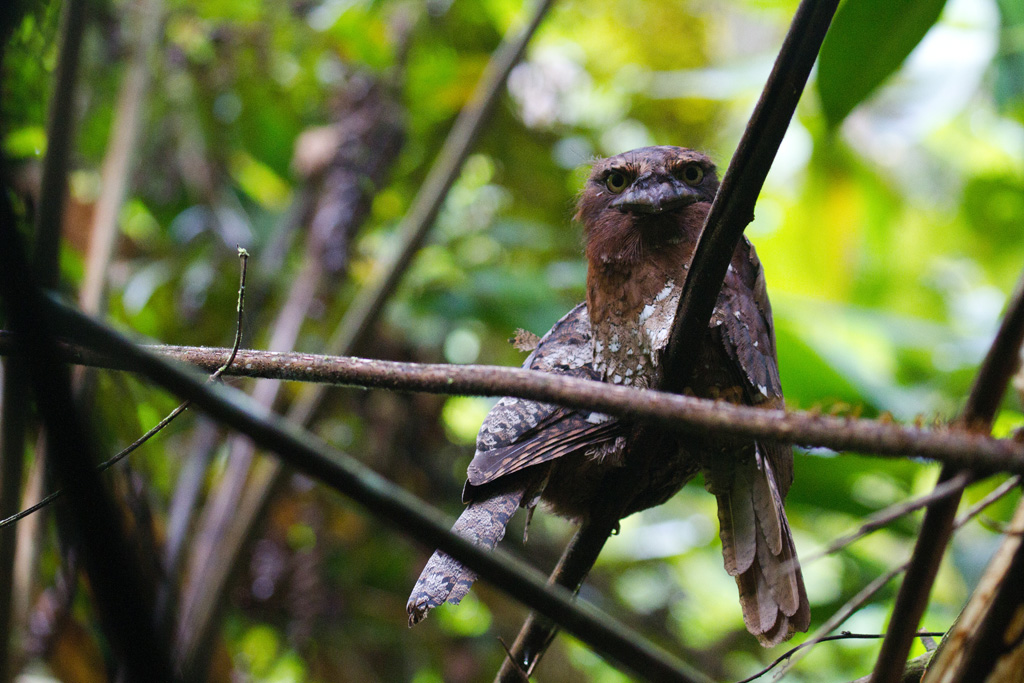
Sri Lankan Frogmouth - Sinharaja, Sri Lanka

A Pair of Sri Lankan Frogmouths photographed in Sinharaja, Sri Lanka
Sri Lankan Frogmouth - Sinharaja, Sri Lanka

One of the highlights of our recent trip to Sinharaja was being able to photograph the Sri Lankan Frogmouth. When I was planning the trip I did wonder whether we'd actually get to see one of these birds but I didn't get my hopes up because they are nocturnal. We were quite fortunate to come across a pair of them in a daytime roost.

More photographs after the jump.

A Pair of Sri Lankan Frogmouths photographed in Sinharaja, Sri Lanka
 Sri Lankan Frogmouth - Sinharaja, Sri Lanka

The birds are found throughout the Western Ghats of India and in Sri Lanka. Their habitat consists of dense tropical forest with thick undergrowth. The guide we were with did a good job locating this pair as they were hidden deep in the undergrowth well off the track. Their plumage helps them blend into the gloomy environment as well. However, the fact that they use the same daytime roosts for up to a month worked in our favour.

A Pair of Sri Lankan Frogmouths photographed in Sinharaja, Sri Lanka

Sri Lankan Frogmouth - Sinharaja, Sri Lanka

I was actually quite surprised by the size of the Sri Lankan Frogmouth. I had seen the Tawny Frogmouth in Australia and was expecting the Sri Lankan Frogmouth to be a similar size but it was actually 2/3 the size of the Tawny Frogmouth. 

A Pair of Sri Lankan Frogmouths photographed in Sinharaja, Sri Lanka
Sri Lankan Frogmouth - Sinharaja, Sri Lanka

Photographing this pair was quite a challenge. Firstly, the dense undergrowth limited the choice of compositions that were available. As you can see in these photographs, there is a branch that was diagonally between the two birds and made it impossible to get a clear shot. Secondly the light wasn't great. I had to bump up the ISO a fair bit to be able to use a shutter speed of 1/125th. There was no room to setup a tripod.

These photograph were taken with a Canon 7D and the 100-400mm lens.

Thursday, June 16, 2011

Red Browed Finch

Red-browed Finch - Neochmia temporalis

The Red-browed Finch was one of several species we spotted around the Barrington tops area. Although it wasn't a lifer for me, it was the first time I managed to photograph them. Photographing them isn't easy as they are constantly moving while they forage on the floor. They were feeding in the undergrowth and the combination of the canopy and the undergrowth guaranteed that the quality of light wasn't the best.

More photographs after the jump.


Red-browed Finch - Neochmia temporalis

There are four "races" of Red-browed Finch and they are spread along the east coast of Australia. They are found in undergrowth forests, grassy clearings, coastal scrubs, heath, mangrove habitats. Females are similar in appearance to mails. This Red-browed Finch is also known as Red-browed Firetails.

Red-browed Finch - Neochmia temporalis

I used the 100-400mm Canon lens and the 7D to photograph these birds. I pushed up the ISO to about 400 from memory for these shots. In hindsight I should have pushed it up a bit more!

Red-browed Finch - Neochmia temporalis

Friday, May 27, 2011

Australian King Parrot

Male Australian King Parrot - Alisterus scapularis

The male Australian King Parrot is the only parrot with a completely red heard. During mating season their habitat is limited to heavier coastal and mountain forests on the south east coast of Australia. Once they have nested, king parrots will frequent farms, parks and even gardens in the area.

More photographs inside.

 Female Australian King Parrot - Alisterus scapularis

Although these Parrots frequent parks and gardens, including ours, I hadn't got around to photographing them. While we were at the Barrington tops I noticed a number of them around and took the opportunity to capture these images. It wasn't too easy to get close to them but fortunately I had the 100-400mm lens with me.

Male Australian King Parrot - Alisterus scapularis

The male and the female are easily identifiable as the female has a green head and the male's head is completely red in colour. The eye of the adult birds is yellow while juveniles have brown eyes. The birds are generally found in pairs or small flocks. I noticed that the birds which frequent camp sites are a lot easier to approach as they are used to people feeding them. 

Male Australian King Parrot - Alisterus scapularis

All these photographs were captured with the Canon 7D and the 100-400mm combination. I loved the bokeh on the first image and, as a result, decided to use it as the lead image for this post. 

Male Australian King Parrot - Alisterus scapularis

Friday, May 20, 2011

Satin Bower Bird

Female Satin Bowerbird - Ptilonorhynchus violaceus

The Satin Bowerbird is the best know of Australia's Bowebirds and can be found along the coast of New South Wales and Southern Queensland. I had seen the male in the Royal National Park on a number of occasions (record shot inside) but hadn't been able to see the female until recently. Due to its size and calls, it is relatively easy to identify as it draws attention to itself. I was able to tick off the female Bowerbird on our trip to the Barrington tops. A number of females Bowerbirds frequented the area near where we stayed and provided me with a number of opportunities to photograph them.

More images after the jump.


Male Satin Bowerbird - Ptilonorhynchus violaceus

The photograph of the male above was a record shot taken in the Royal National Park, south of Sydney. A better shot of a male Satin Bowerbird is on my shot list! Both male and female juvenile Satin Bowerbirds look like the female to being with. The male starts changing around the third year with the overall blue-black plumage not appearing until the seventh year. 

Female Satin Bowerbird - Ptilonorhynchus violaceus

The Bowerbirds have bright lilac coloured eyes which make them unmistakable.   They are usually seen in rainforests and wet eucalyptus forests but move out to more open woodlands throughout the autumn and winter months. 

Female Satin Bowerbird - Ptilonorhynchus violaceus

The photographs of the female Satin Bowerbird were captured with a Canon 7D and the 100-400mm lens. A Canon 400D was used for the photograph of the male.

Friday, May 6, 2011

Crimson Rosella

Crimson Rosella - Platycercus elegans

The Crimson Rosella, although relatively common, has not been the easiest bird for me to photograph. I had seen them on a number of occasions along the east coast of Australia but hadn't been able to get a clear shot. I found a few of them around where we stayed in the Barrington Tops and was finally able to get some unobstructed photographs of these birds.

More images after the jump.
Crimson Rosella - Platycercus elegans

I found them frequenting a small creek that ran behind the house where we were staying. They would arrive there at roughly the same time each morning which made things a bit easier for me. I was able to photograph them while they were feeding and also while they were cleaning themselves in the stream.

Crimson Rosella - Platycercus elegans

The light wasn't the best as there the creek was in a valley and there was a fairly dense canopy overhead. The birds moved around a lot and I had to use a fast shutter speed to capture these images. In order to get around the problem with the light, I had to bump up the ISO. I generally try to keep the ISO at 100 but the 7D performs pretty well in this regard.
Crimson Rosella - Platycercus elegans

All the images on this post were captured with a Canon 7D and the 100-400mm lens. 

Crimson Rosella - Platycercus elegans
 Crimson Rosella - Platycercus elegans

Saturday, December 11, 2010

Wagtail

Willie Wagtail (Rhipidura leucophrys) - New South Wales, Australia
Willie Wagtail (Rhipidura leucophrys) - New South Wales, Australia 

I thought I'd go back to my bird / wildlife photographs for a change and give you guys a break from Europe.

The wagtail is a common resident found throughout Australia. It is very restless and its name is derived from the fact that it constantly waves its tail from side to side. It is the best known of the Australian Fantails. I have photographed these birds in Sydney, in the hunter region and at Myall lakes on the Central Coast of New South Wales.

Willie Wagtail (Rhipidura leucophrys) - New South Wales, Australia

The nesting Wagtail in the photograph above was feeding a brood of two or three chicks. The nest was built on a branch above a lake and was not easy to spot. The adult birds, who are aggressive when protecting a nest, gave away their location as they were flying in at regular intervals to feed the young. I did my best to not disturb them while taking the photographs above. They didn't seem too bothered by my presence as they just continued flying in at regular intervals with food.

Willie Wagtail (Rhipidura leucophrys) - New South Wales, Australia

The other photographs on this post were captured on  friends farm in the Hunter region of New South Wales. Farms are ideal habitats for these birds as they prefer open grassland. I watched a couple of these birds for a while as they fed on small insects. They used sudden flicks of their wings to flush out hidden insects.

Willie Wagtail (Rhipidura leucophrys) - New South Wales, Australia

The Wagtail is found throughout mainland Australia but its habitat does not extend to Tasmania. It is also found on the Solomon Islands and New Guinea. The nest of the Willie Wagtail is lined with some sort of soft material, usually soft grass, fur or hair. Interestingly, if soft material is not readily available, it is often taken directly from an animal.

Willie Wagtail (Rhipidura leucophrys) - New South Wales, Australia

The second image was captured with a Canon 400d and a 70-300mm lens. The other images were captured with a Canon 7D and a 100-400 mm lens.