Showing posts with label Sri Lanka. Show all posts

Saturday, December 17, 2011

Common Sailor - Thalangama, Sri Lanka

A Photograph of the Common Sailor Butterfly (Neptis hylas) taken in Thalangama, Sri Lanka
Common Sailor (Neptis hylas) - Thalangama, Sri Lanka

The wetlands in Thalangama are best known for the bird life around the marshes but they are also home to a large number of butterflies. I have seen and photographed the Common Sailor (Neptis hylas) at Thalangama on numerous occasions but, for some reason, never got around to posting them on the blog.

More photographs inside.
A Photograph of the Common Sailor Butterfly (Neptis hylas) taken in Thalangama, Sri Lanka
Common Sailor (Neptis hylas) - Thalangama, Sri Lanka

The Common Sailor is found throughout India, Sri Lanka and Burma. Its range is said to extend to Indomalaya as well. It has a wet and dry season form which only differs in the narrowness of the white markings on the wings. This species has been observed making sounds by clicking its foremost pair of legs. However, the reason for this behaviour has not been identified.

A Photograph of the Common Sailor Butterfly (Neptis hylas) taken in Thalangama, Sri Lanka
Common Sailor (Neptis hylas) - Thalangama, Sri Lanka

I did find photographing this species relatively easy as they let me get quite close to them. Most of my trips to Thalangama are early in the morning so this may have helped. The Common sailor is known for settling on damp patches, a behaviour I witnessed in Kandy (photograph below).

A Photograph of the Common Sailor Butterfly (Neptis hylas) taken in Kandy, Sri Lanka
Common Sailor (Neptis hylas) - Kandy, Sri Lanka

All photographs on this post were taken with the Canon 7D and the 100-400mm lens. I didn't have to use flashes to light the images as the ambient light was sufficient. I did have to bump up the ISO to 400 though.


Wednesday, December 14, 2011

Coppersmith Barbet - Anuradhapura, Sri Lanka

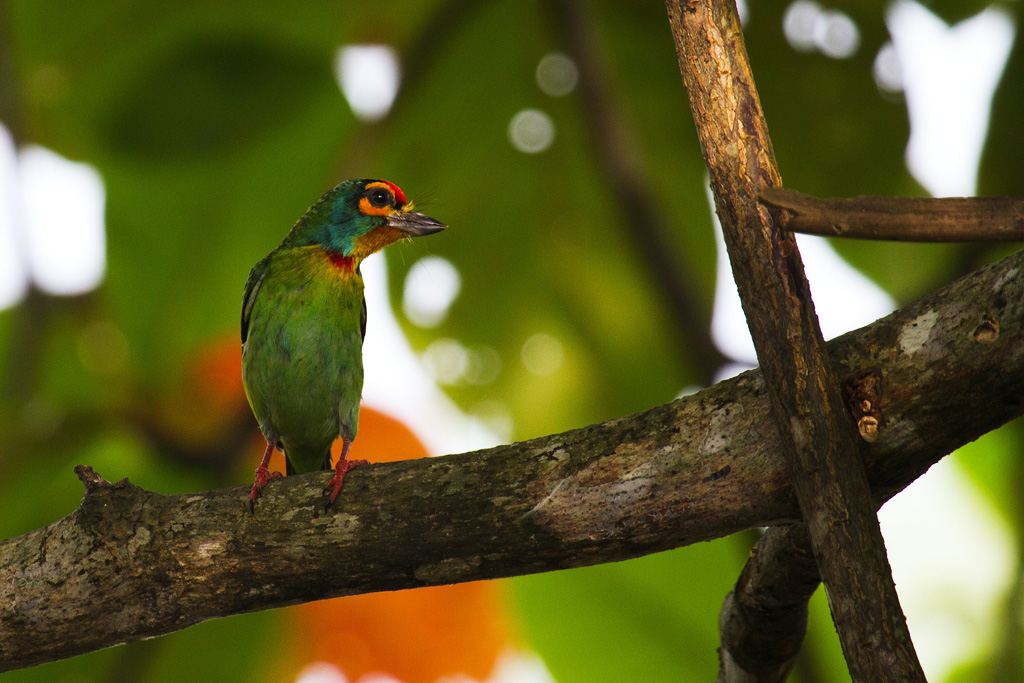
The Coppersmith Barbet phoographed in Anuradhapura, Sri Lanka
The Coppersmith Barbet - Anuradhapura, Sri Lanka

Of the resident Barbets of Sri Lanka, I have found the Coppersmith, or Crimson-breasted Barbet (Megalaima haemacephala), the hardest to photograph. I had seen the bird before but it had always been from a distance. Those sightings were not the best for photographing the Barbet as it is quite small.

The Coppersmith Barbet phoographed in Anuradhapura, Sri Lanka
The Coppersmith Barbet - Anuradhapura, Sri Lanka

My luck changed in July when I found a nest just outside the house in Anuradhapura. I was able to photograph the parents on a fairly regular basis from the verandah, as they flew in to feed the chicks. Each time they flew in with food, they appeared to clean up the nest and fly away with the rubbish.

The Coppersmith Barbet phoographed in Anuradhapura, Sri Lanka
The Coppersmith Barbet - Anuradhapura, Sri Lanka

According to GM Henry (Birds of Ceylon, 1954), the Coppersmith is found in the dry zone of sri Lanka and "does not penetrate far into the districts which receive the south west monsoon". However, they are not endemic and can be found in South and Southeast Asia. When compared to the other Barbets found in Sri Lanka, it is most similar to the Ceylon small Barbet. However, the Coppersmiths large red breast patch, pale yellow face and dusky green colouration help differentiate the two species.

The Coppersmith Barbet phoographed in Anuradhapura, Sri Lanka
The Coppersmith Barbet - Anuradhapura, Sri Lanka

These photographs were taken with a Canon 7D and the Canon 100-400mm lens. Conditions were not the best as the bird was in the shade and the sky in the background was blown out. Hopefully I'll get an opportunity to improve on these shots soon.


Wednesday, December 7, 2011

Ceylon Small Barbet - Thalangama, Sri Lanka

Photograph of a Ceylon Small Barbet taken in Thalangama, Sri Lanka
Ceylon Small Barbet - Thalangama, Sri Lanka

I have photographed the Ceylon Small Barbet (Megalaima rubricapilla), also called the Crimson-fronted Barbet, on several occasions. I have found them in the garden at home in Colombo and they are abundant at our place in Kandy. However, on these occasions the birds were some distance away.

More photographs inside.

Photograph of a Ceylon Small Barbet taken in Thalangama, Sri Lanka
 Ceylon Small Barbet - Thalangama, Sri Lanka

My luck changed on one of several visits to Thalangama in July. While I was walking along the bank of the tank I noticed a Black-rumped Flameback in one of the trees by the road. I stopped and photographed it for a few minutes and then noticed that a Golden Oriole had settled in the same tree. I was in the middle of photographing the Oriole when a Ceylon Small Barbet flew down onto one of the lower branches of the same tree.

Photograph of a Ceylon Small Barbet taken in Thalangama, Sri Lanka
Ceylon Small Barbet - Thalangama, Sri Lanka

I fired off about 15 or 20 frames and then stopped to watch the bird as I had not seen it in such close proximity before. My presence didn't seem to disturb it as it soon started moving along the branch pecking at the bark and foraging for insects.  It gradually worked its way up into the canopy and disappeared. Due to the colour of its plumage, it is not the easiest bird to find in the canopy.

Photograph of a Ceylon Small Barbet taken in Thalangama, Sri Lanka
Ceylon Small Barbet - Thalangama, Sri Lanka

These photographs were taken with the Canon 7D and the 100-400mm lens.The light wasn't the best and I bumped up the ISO to compensate.


Saturday, December 3, 2011

Variegated Flutterer - Thalangama, Sri Lanka

Variegated Flutterer (male) - Thalangama, Sri Lanka

The Variegated Fluterer (Rhyothemis variegata variegata) was one of several dragonflies I photographed while in Sri Lanka. They are relatively common and since they are found around ponds, paddy fields and tanks, Thalangama is an ideal location to photograph them. It is also known as the Common Picture Wing.

More photographs after the jump.

Variegated Flutterer (female) - Thalangama, Sri Lanka

In terms of appearance, the female is slightly different when compared to the male Variegated Flutterer. The tip of the females wings are clear where as the tips of the male's wings are black in colour (see first and third images on this post).

Variegated Flutterer (male) - Thalangama, Sri Lanka

The Variegated Flutterer is a relatively small dragon fly with an abdomen measuring 20-25mm and a wingspan of 34-37mm. It is easily identifiable because of the variegated blackish-brown and golden yellow patterns on the wings.

Variegated Flutterer (male) - Thalangama, Sri Lanka

All photographs on this post were taken with the Canon 100-400mm lens and the Canon 7D.

Wednesday, November 30, 2011

Thanthirimale - Anuradhapura, Sri Lanka

photographs from the temple at Thanthirimale - Anuradhapura, Sri Lanka
Thanthirimale - Anuradhapura, Sri Lanka

Thanthirimale is a small village which lies in thick jungle approximately 40 km away from Anuradhapura. The temple in Thanthirimale is both religiously and historically significant and still attracts thousands of pilgrims during Poson. The history of Thanthirimale is said to date back to the 6th Century BC.

More photographs inside.
photographs from the temple at Thanthirimale - Anuradhapura, Sri Lanka
 Thanthirimale - Anuradhapura, Sri Lanka

References to Thanthirimale can be found in the Mahavamsa in the sections that describe the Bo (Ficus religiosa) sapling being brought to Sri Lanka during the reign of King Devanampiyatissa. The Bo tree in the temple is said to be a sapling from the sacred Bo tree in Mahamewuna Uyana.

photographs from the temple at Thanthirimale - Anuradhapura, Sri Lanka
Thanthirimale - Anuradhapura, Sri Lanka

There are five ancient Buddha statues, four of which are incomplete (6th image on the post), on the temple premises. The largest of these is the sleeping Buddha (photograph above) which has been carved out of the rock. Surprisingly, the proportions of the statue seemed to be incorrect as the legs look short when compared with the size of the upper body. This is the first time that I'd actually seen an ancient statue that was out of proportion.

photographs from the temple at Thanthirimale - Anuradhapura, Sri Lanka
Thanthirimale - Anuradhapura, Sri Lanka

The remains of an ancient library have been found on the premises. A number of rock huts and caves, which have most probably been used for meditation by monks for centuries, have also been discovered on the site.

photographs from the temple at Thanthirimale - Anuradhapura, Sri Lanka
Thanthirimale - Anuradhapura, Sri Lanka

In 1909 archeological evidence was found in a cave close to the temple which suggests that a prehistoric civilization existed in this area. The evidence included fragments of cherts, a piece of crystal and drawings, which are still visible, on the walls of a cave.

photographs from the temple at Thanthirimale - Anuradhapura, Sri Lanka
Thanthirimale - Anuradhapura, Sri Lanka

To top off the day we witnessed a stunning sunset on the drive back.

All photographs on this post were taken with the Canon 7D and the 24-105mm lens.

photographs from the temple at Thanthirimale - Anuradhapura, Sri Lanka
Thanthirimale - Anuradhapura, Sri Lanka


Wednesday, November 23, 2011

Purple Coot - Thalangama, Sri Lanka

A photograph of a Purple Coot taken in Thalangama, Sri Lanka
Purple Coot - Thalangama, Sri Lanka

The Purple Coot, also know as the Purple Swamphen, is a common bird found in the lowland marshes of Sri Lanka. The subspecies found in Sri Lanka, Porphyrio porphyrio poliocephalus, is one of up to 13 subspecies identified through Europe, Africa, Asia and Australia. The thirteen subspecies mainly differ in the colour of their plumage.

More photographs after the jump.
A photograph of a Purple Coot taken in Thalangama, Sri Lanka
Purple Coot - Thalangama, Sri Lanka

Purple Coots are easy to identify because of their bright plumage and loud call. It is said to be able to fly long distances and for a bird without webbed feet, it is a good swimmer. They are seasonal breeders but the seasons vary across their range. The season correlates to the peak rainfall or summer temperatures in more temperate climates.

A photograph of a Purple Coot taken in Thalangama, Sri Lanka
Purple Coot - Thalangama, Sri Lanka

Multiple females may lay eggs in the same nest, which is built amongst reeds or other debris, and share incubation duties. Incubation lasts from 23-27 days and is performed by both males and females. "Helpers" are also known to assist with the incubation. After hatching, chicks are fed for a period of 10-15 days, after which they fend for themselves.

A photograph of a Purple Coot taken in Thalangama, Sri Lanka
Purple Coot - Thalangama, Sri Lanka 

Although the species is considered to be in the "least concern" category according to the IUCN, some subspecies have declined. This includes the subspecies found in the Mediterranean. An introduced population exists in Florida but biologists are trying to eradicate them.

A photograph of a Purple Coot taken in Thalangama, Sri Lanka
Purple Coot - Thalangama, Sri Lanka

These photographs were taken with the Canon 7D and the 100-400mm lens combo during several early morning visits to Thalangama.


Wednesday, November 16, 2011

The Leopards at Wel Mal Kema - Yala, Sri Lanka

Leopard at Wel Mal Kema - Yala, Sri Lanka

Wel Mal Kema is a rocky area within block 1 of the Yala national park. There are a couple of water holes amongst the rocks and apart from the rock itself, there aren't any open areas. The road actually runs up the rock and relatively close to one of the water holes. The area is known for Leopard and Bear.  It's not the easiest road to drive along.

More photographs inside.

Leopard at Wel Mal Kema - Yala, Sri Lanka

On our first drive through Wel Mal Kema we found fresh Leopard tracks along one side of the road. We knew the Leopard was close by but visibility wasn't the best due to the thick jungle on either side of the road. Our best chance of seeing the Leopard was if it was on the road.  Fortunately for us it was. We saw it from about 25 meters away as it peered around a rock to watch us. The engine was promptly tuned off and we waited hoping to get a better view.

Leopard at Wel Mal Kema - Yala, Sri Lanka

After a few minutes the Leopard crossed the road and climbed up on the rocks to our right. Unfortunately for us another jeep pulled up at that moment and the inexperienced driver (there are a lot of them around Yala) didn't turn off his engine and the Leopard got spooked and left.

Leopard at Wel Mal Kema - Yala, Sri Lanka

On another one of our trips we had a brief sighting of a Leopard as it walked away from the road. I did manager to get a couple of photographs of the Leopard as it walked away and scent marked a tree.

All the images on this post were taken with the Canon 7D and the 100-400mm lens.


Wednesday, November 9, 2011

Ruwanweliseya - Anuradhapura, Sri Lanka

Ruwanweliseya - Anuradhapura, Sri Lanka

During our trip to Anuradhapura in July I decided to head out early morning to photograph some of the main stupas in the area. I first visited Thuparamaya and then walked around the complex in the general direction of Ruwanweliseya. At 6.00 AM you pretty much have the whole area to yourself as it is way too early in the morning for tourists and pilgrims. The light being at it's best is an added bonus.

More photographs inside.
Ruwanweliseya from the Thuparamaya complex - Anuradhapura, Sri Lanka

After spending sometime wandering around the Thuparamaya complex I drove along the the bund of the Basawakkulama tank (Sri Lankans use the word tank to refer to man made lakes which are found throughout the dry zone of the island) taking in the views. I was able to use the trees along the bund in an number of different compositions.

Ruwanweliseya across Basawakkulama - Anuradhapura, Sri Lanka

The area surrounding the Abhayagiriya complex was my last stop for the morning. Ruwanweliseya is a massive stupa and it towers above the trees and other buildings in the area. It is clearly visible form a number of locations around Anuradhapura. I caught a glimpse of it across some paddy fields close to Abhayagiriya and hopped out to take a few photographs. I was fortunate to be there as some farmers started their days work and included them in the foreground of the image. I personally think they add another layer of foreground interest to this photograph.

Ruwanweliseya - Anuradhapura, Sri Lanka

All photographs on this post were taken with a Canon 7D and the 24-105mm lens. I think I should have used a graduated ND filter but unfortunately it didn't cross my mind at the time.


Thursday, November 3, 2011

Tickell's Blue Flycatcher - Kandy, Sri Lanka

A photograph of a Tickell's Blue Flycatcher taken in Kandy, Sri Lanka
Tickell's Blue Flycatcher - Kandy, Sri Lanka

One of the best sightings that I have had of the Tickell's Blue Flycatcher was in Kandy in July. The bird made several appearances and spent quite a bit of time around the house, allowing me to photograph it. I would have liked to get a lot closer to it but unfortunately this was not possible.

More photographs inside.
A photograph of a Tickell's Blue Flycatcher taken in Kandy, Sri Lanka
 Tickell's Blue Flycatcher - Kandy, Sri Lanka

The Tickell's Blue Flycatcher is a relatively common resident and is often seen from the wet lowlands to the mid hills of Sri Lanka. It may also be found in suitable forests in the dry zone. The female is duller in colour and has a lighter throat and breast. Based on this, I believe the bird pictured in this post is a male.

A photograph of a Tickell's Blue Flycatcher taken in Kandy, Sri Lanka
Tickell's Blue Flycatcher - Kandy, Sri Lanka

This species breeds in tropical south Asia and its range extends east from India and Sri Lanka to Indonesia. It shows regional variations in plumage and size with several of these variations being designated as subspecies. The Sri Lankan population is a separate subspecies named jerdoni.   

A photograph of a Tickell's Blue Flycatcher taken in Kandy, Sri Lanka
Tickell's Blue Flycatcher - Kandy, Sri Lanka

All photographs on this post were taken with the Canon 7D and the 100-400mm combo.


Thursday, October 27, 2011

Common Iora - Thalangama and Yala, Sri Lanka

Photograph of a female Common Iora taken in Thalangama, Sri Lanka
Common Iora (female) - Thalangama, Sri Lanka

While I was in Colombo in July I visited the Thalangama wetlands almost every morning to photograph the bird life. On one of my visits I came across a few Common Ioras. I hadn't photographed them before and took the opportunity to shoot a few frames. The photograph above is one of my favourites because of the warm early morning light on the bird.

More photographs inside.

Photograph of a male Common Iora taken in Yala, Sri Lanka
Common Iora (male) - Yala, Sri Lanka

The males proved to be a bit more elusive and I wasn't able to get many shots of them. Males are unmistakable as their upper parts are a blue-black in colour where as the females are a dull yellow. The Common Iora is found throughout the lowlands and the mid hills of Sri Lanka. It is a very vocal bird but can be difficult to see due to it's plumage.

Photograph of a female Common Iora taken in Yala, Sri Lanka
Common Iora (female) - Yala, Sri Lanka

The male Common Iora is said to perform an "acrobatic courtship display" during the breeding season. It is said to puff up it's feathers and dart into the air and spiral back to the same perch. Once it lands, it spreads its tail and droops its wings. I am yet to see this performance.

Photograph of a female Common Iora taken in Thalangama, Sri Lanka
Common Iora (female) - Yala, Sri Lanka

All the photographs on this post were taken with a Canon 7D and the 100-400mm lens. I did push up the ISO to allow me to use a faster shutter.


Thursday, October 20, 2011

The Statues at Maligawila - Maligawila, Sri Lanka

The Maligawila Buddha Statue - Maligawila, Sri Lanka

Maligawila is a small village approximately 250km from Colombo. The area is sparsely populated and is covered in jungle. In 1951 the fallen remains of a 7th century giant free standing Buddha statue (said to be the tallest free standing Buddha statue in Sri Lanka) were discovered in the area. The statue was part of a larger complex which also included a large statue thought to be of the Avalokitheswara Bodhisatva and a gedi ge (A Buddhist shrine).

More images inside.

The Maligawila Buddha Statue - Maligawila, Sri Lanka
 The Maligawila Buddha Statue - Maligawila, Sri Lanka

The Buddha statue is carved out of a single limestone rock and stands at a height of around 14 meters. When it was first discovered in 1951, it had fallen and was broken into pieces by a combination of the fall and treasure hunters. The first attempt of raising the statue was made in 1974 but was unsuccessful. The statue was finally raised and  restored in 1980 by a team of local engineers.

The Maligawila Buddha Statue - Maligawila, Sri Lanka

The statue was said to have been built by a King named Aggabodhi who ruled the southern region of Sri Lanka in the 7th century. A stone pillar found within the complex also documents the work done by King Mahinda IV (956 - 972 AD) to uplift Buddhism and also defines the rules laid down for the administration of Buddhist sites.

Statue of the Avalokitheswara Bodhisatva - Maligawila, Sri Lanka

The statue of the Avalokitheswara Bodhistva is a short distance away from the Buddha statue. It too is carved out of a single limestone rock and stands at a height of approximately 10 meters. This statue too was found broken into several pieces due to its fall and the damage done by treasure hunters. The intricate details on the face of this statue have been preserved quite well due to the fact that the head had been lying face down for  an extended period of time (possibly hundreds of years). It was successfully restored in 1990. When we visited in July this year we found a scaffolding around it and more restoration work in progress.

All images on this post were captured with a Canon 7D and the 24 - 105mm lens.


Wednesday, October 12, 2011

The Hybrid Black-rumped Flameback - Anuradhapura, Sri Lanka

 The Hybrid Black-rumped Flameback - Anuradhapura, Sri Lanka
The Hybrid Black-rumped Flameback - Anuradhapura, Sri Lanka

I had been hoping to photograph the hybrid species of the black-rumped Flameback for a couple of years but didn't get a chance to do so until recently. The closest I came to photographing it before our recent trip to Sri Lanka was in Anuradhapura in 2009. The bird visited the garden while I was away photographing butterflies!

More images inside.

 The Hybrid Black-rumped Flameback - Anuradhapura, Sri Lanka
 The Hybrid Black-rumped Flameback - Anuradhapura, Sri Lanka

The subspecies of Flameback found in the southern part of Sri Lanka (Dinopium benghalense psarodes) has a crimson back and the dark markings are blacker in colour and are more extensive. The subspecies found in the north of Sri Lanka (jaffnense) has a golden back and a shorter beak.

 The Hybrid Black-rumped Flameback - Anuradhapura, Sri Lanka
The Hybrid Black-rumped Flameback - Anuradhapura, Sri Lanka

The species "hybradises" in Puttalam, Kekirawa, Trincomalee and Anuradhapura. I came across a pair of Flamebacks near Abhayagiriya and found that one of them was actually a hybrid (See the 3 photographs above). Fortunately I had my camera gear with me and was able to take a number of photographs of the pair.

 The Hybrid Black-rumped Flameback - Anuradhapura, Sri Lanka
The Hybrid Black-rumped Flameback - Anuradhapura, Sri Lanka

I'm not sure whether the second bird, photograph above, was actually a hybrid. The variation in colour was a lot more subtle but I thought there was a variation. I visited the same area again the following day hoping to shoot a few more frames of the pair but they did not make an appearance. 

Next on the list of shots would be to photograph the Northern Sri Lankan species as well as better shots of the hybrid.

All the photographs on this post were taken with the 7D and the 100-400mm lens.