Showing posts with label thalangama. Show all posts

Saturday, December 17, 2011

Common Sailor - Thalangama, Sri Lanka

A Photograph of the Common Sailor Butterfly (Neptis hylas) taken in Thalangama, Sri Lanka
Common Sailor (Neptis hylas) - Thalangama, Sri Lanka

The wetlands in Thalangama are best known for the bird life around the marshes but they are also home to a large number of butterflies. I have seen and photographed the Common Sailor (Neptis hylas) at Thalangama on numerous occasions but, for some reason, never got around to posting them on the blog.

More photographs inside.
A Photograph of the Common Sailor Butterfly (Neptis hylas) taken in Thalangama, Sri Lanka
Common Sailor (Neptis hylas) - Thalangama, Sri Lanka

The Common Sailor is found throughout India, Sri Lanka and Burma. Its range is said to extend to Indomalaya as well. It has a wet and dry season form which only differs in the narrowness of the white markings on the wings. This species has been observed making sounds by clicking its foremost pair of legs. However, the reason for this behaviour has not been identified.

A Photograph of the Common Sailor Butterfly (Neptis hylas) taken in Thalangama, Sri Lanka
Common Sailor (Neptis hylas) - Thalangama, Sri Lanka

I did find photographing this species relatively easy as they let me get quite close to them. Most of my trips to Thalangama are early in the morning so this may have helped. The Common sailor is known for settling on damp patches, a behaviour I witnessed in Kandy (photograph below).

A Photograph of the Common Sailor Butterfly (Neptis hylas) taken in Kandy, Sri Lanka
Common Sailor (Neptis hylas) - Kandy, Sri Lanka

All photographs on this post were taken with the Canon 7D and the 100-400mm lens. I didn't have to use flashes to light the images as the ambient light was sufficient. I did have to bump up the ISO to 400 though.


Wednesday, December 7, 2011

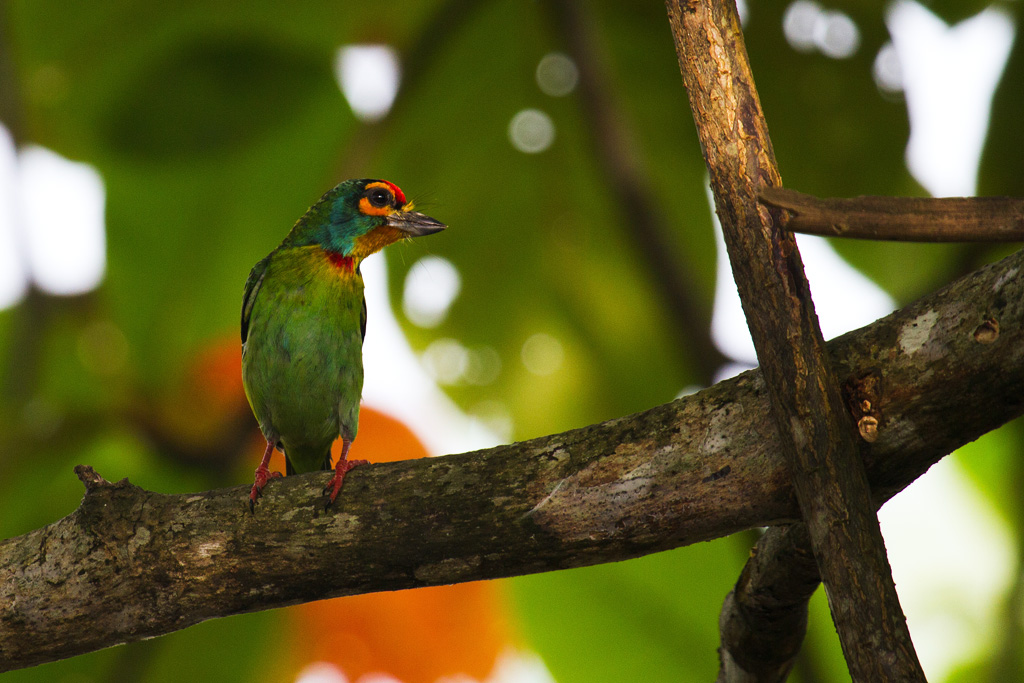
Ceylon Small Barbet - Thalangama, Sri Lanka

Photograph of a Ceylon Small Barbet taken in Thalangama, Sri Lanka
Ceylon Small Barbet - Thalangama, Sri Lanka

I have photographed the Ceylon Small Barbet (Megalaima rubricapilla), also called the Crimson-fronted Barbet, on several occasions. I have found them in the garden at home in Colombo and they are abundant at our place in Kandy. However, on these occasions the birds were some distance away.

More photographs inside.

Photograph of a Ceylon Small Barbet taken in Thalangama, Sri Lanka
 Ceylon Small Barbet - Thalangama, Sri Lanka

My luck changed on one of several visits to Thalangama in July. While I was walking along the bank of the tank I noticed a Black-rumped Flameback in one of the trees by the road. I stopped and photographed it for a few minutes and then noticed that a Golden Oriole had settled in the same tree. I was in the middle of photographing the Oriole when a Ceylon Small Barbet flew down onto one of the lower branches of the same tree.

Photograph of a Ceylon Small Barbet taken in Thalangama, Sri Lanka
Ceylon Small Barbet - Thalangama, Sri Lanka

I fired off about 15 or 20 frames and then stopped to watch the bird as I had not seen it in such close proximity before. My presence didn't seem to disturb it as it soon started moving along the branch pecking at the bark and foraging for insects.  It gradually worked its way up into the canopy and disappeared. Due to the colour of its plumage, it is not the easiest bird to find in the canopy.

Photograph of a Ceylon Small Barbet taken in Thalangama, Sri Lanka
Ceylon Small Barbet - Thalangama, Sri Lanka

These photographs were taken with the Canon 7D and the 100-400mm lens.The light wasn't the best and I bumped up the ISO to compensate.


Saturday, December 3, 2011

Variegated Flutterer - Thalangama, Sri Lanka

Variegated Flutterer (male) - Thalangama, Sri Lanka

The Variegated Fluterer (Rhyothemis variegata variegata) was one of several dragonflies I photographed while in Sri Lanka. They are relatively common and since they are found around ponds, paddy fields and tanks, Thalangama is an ideal location to photograph them. It is also known as the Common Picture Wing.

More photographs after the jump.

Variegated Flutterer (female) - Thalangama, Sri Lanka

In terms of appearance, the female is slightly different when compared to the male Variegated Flutterer. The tip of the females wings are clear where as the tips of the male's wings are black in colour (see first and third images on this post).

Variegated Flutterer (male) - Thalangama, Sri Lanka

The Variegated Flutterer is a relatively small dragon fly with an abdomen measuring 20-25mm and a wingspan of 34-37mm. It is easily identifiable because of the variegated blackish-brown and golden yellow patterns on the wings.

Variegated Flutterer (male) - Thalangama, Sri Lanka

All photographs on this post were taken with the Canon 100-400mm lens and the Canon 7D.

Wednesday, November 23, 2011

Purple Coot - Thalangama, Sri Lanka

A photograph of a Purple Coot taken in Thalangama, Sri Lanka
Purple Coot - Thalangama, Sri Lanka

The Purple Coot, also know as the Purple Swamphen, is a common bird found in the lowland marshes of Sri Lanka. The subspecies found in Sri Lanka, Porphyrio porphyrio poliocephalus, is one of up to 13 subspecies identified through Europe, Africa, Asia and Australia. The thirteen subspecies mainly differ in the colour of their plumage.

More photographs after the jump.
A photograph of a Purple Coot taken in Thalangama, Sri Lanka
Purple Coot - Thalangama, Sri Lanka

Purple Coots are easy to identify because of their bright plumage and loud call. It is said to be able to fly long distances and for a bird without webbed feet, it is a good swimmer. They are seasonal breeders but the seasons vary across their range. The season correlates to the peak rainfall or summer temperatures in more temperate climates.

A photograph of a Purple Coot taken in Thalangama, Sri Lanka
Purple Coot - Thalangama, Sri Lanka

Multiple females may lay eggs in the same nest, which is built amongst reeds or other debris, and share incubation duties. Incubation lasts from 23-27 days and is performed by both males and females. "Helpers" are also known to assist with the incubation. After hatching, chicks are fed for a period of 10-15 days, after which they fend for themselves.

A photograph of a Purple Coot taken in Thalangama, Sri Lanka
Purple Coot - Thalangama, Sri Lanka 

Although the species is considered to be in the "least concern" category according to the IUCN, some subspecies have declined. This includes the subspecies found in the Mediterranean. An introduced population exists in Florida but biologists are trying to eradicate them.

A photograph of a Purple Coot taken in Thalangama, Sri Lanka
Purple Coot - Thalangama, Sri Lanka

These photographs were taken with the Canon 7D and the 100-400mm lens combo during several early morning visits to Thalangama.


Thursday, October 27, 2011

Common Iora - Thalangama and Yala, Sri Lanka

Photograph of a female Common Iora taken in Thalangama, Sri Lanka
Common Iora (female) - Thalangama, Sri Lanka

While I was in Colombo in July I visited the Thalangama wetlands almost every morning to photograph the bird life. On one of my visits I came across a few Common Ioras. I hadn't photographed them before and took the opportunity to shoot a few frames. The photograph above is one of my favourites because of the warm early morning light on the bird.

More photographs inside.

Photograph of a male Common Iora taken in Yala, Sri Lanka
Common Iora (male) - Yala, Sri Lanka

The males proved to be a bit more elusive and I wasn't able to get many shots of them. Males are unmistakable as their upper parts are a blue-black in colour where as the females are a dull yellow. The Common Iora is found throughout the lowlands and the mid hills of Sri Lanka. It is a very vocal bird but can be difficult to see due to it's plumage.

Photograph of a female Common Iora taken in Yala, Sri Lanka
Common Iora (female) - Yala, Sri Lanka

The male Common Iora is said to perform an "acrobatic courtship display" during the breeding season. It is said to puff up it's feathers and dart into the air and spiral back to the same perch. Once it lands, it spreads its tail and droops its wings. I am yet to see this performance.

Photograph of a female Common Iora taken in Thalangama, Sri Lanka
Common Iora (female) - Yala, Sri Lanka

All the photographs on this post were taken with a Canon 7D and the 100-400mm lens. I did push up the ISO to allow me to use a faster shutter.


Thursday, November 26, 2009

White-browed Bulbul


The white browed Bulbul is a shy member of the Bulbul family of passerine birds. It is a resident breeder in Sri Lanka and the coasts of peninsular India. More info after the jump.

The white-browed Bulbul is about 20cm in length with a long tail. The upper part of the bird is an olive gray while the under parts are whitish. This species of Bulbul is identified by the white supercilium, the white crescent below the eye and the dark eye stripe. It also has a yellow vent, which is not always seen. The sexes are similar in plumage. It feeds on fruits, nectar and insects. It builds a cup shaped nest in a tree and typically lays two eggs per clutch.

The bird is usually detected by its characteristic call, a "loud rattle of sweetish notes", which is a familiar sound in the dry zone forests of Sri Lanka.

This photograph was taken at the Thalangama tank. I was out looking for Kingfishers when I came around a bend in the road and found it perched on a branch about 6 feet off the ground. It was very close to where I was standing and surprisingly it did not fly off or hide. I took these images at a focal length of 400mm. The light wasn't the best so I had to crank up the ISO to 1600. I was using the 400D at the time and wasn't too happy about increasing the ISO that much. At least I got a half decent image though!